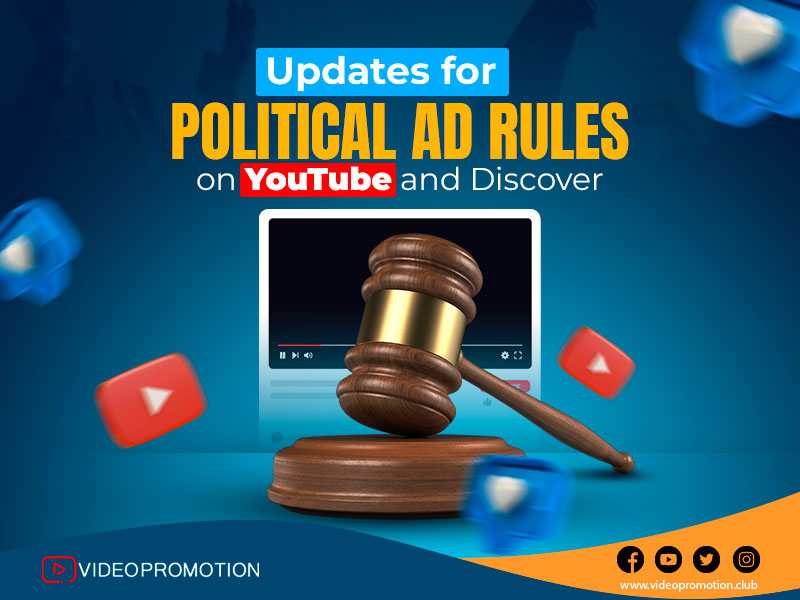
The election season gives a significant
spike to the political ads as these ad campaigns are utilized for marketing and
promotion before the election in order to influence the voters. Since a
significant amount of political ads run through YouTube and Discover, Google is
bringing some changes to the election ads.
Google has recently updated the ad
requirements for its YouTube and Discover Feed, and these updates arrived in
April 2026, as the policies will soon be activated. Google has already
clarified how election ads should be handled without changing the rules that
are already enforced.
Why is this Ad Update so important in
2026?
Advertising by using the platforms of
YouTube Discover is already quite strict with some tight guidelines, and
politics is one of those grey areas where setting up rules and values is
difficult, but important at the same time. This latest update does not add new
or more complex restrictions, but rather removes all the confusion regarding
political ad campaigns. YouTube and Discover themselves work like a neutral
body that is not influenced by any political party or propaganda, but the users
or politicians can still have the right to advertise or post content that
allows gaining attention from more users or individuals who will vote.
What is new in this latest update?
This latest update shows that political ad
campaigns are exempt from ad requirements for YouTube and Discover Feed, but
this is just a clarification, as there are no new updates or enforced changes.
Therefore, advertisers who have already complained before are not required to
change or adjust their approach.
With the election season having
arrived, Google is trying to remove confusion regarding the political ads that
run through unbiased and independent platforms. Although the political ads need
to follow specific requirements for placement, they should still follow rules
and guidelines for Google Ads policies. With clearer guidance, more predictable
campaigns can be launched with fewer approval issues.
Region-Based Political Approach
Since the political scenario is different
in every region and the governments of different countries have different rules
for election-based marketing and celebrity endorsement, Google recommends
advertisers to go through the Election Ads verification process. It allows
getting verified in the region where the ad will run and influence the users.
Although the election ads are not required to follow the Discover Feed ad
requirements, they must follow broader Google Ads policies in order to
qualify for a political ad campaign. Evidently, this is not a shift in policy
but more of a documentation update where Google is offering a clear view of the
placement-specific requirements as well as their differences with the wider ads
policy framework.
What advertisers should do now?
The professional advertisers who are
running political ads and marketing campaigns must complete the verification
process first in order to continue with the modern ad approach and strategy.
Sometimes it can be a little tricky to get out of the ad situation, and that is
when you need professionals to help you out. Hiring a YouTube video promotion
agency like the Video Promotion Club can actually be a good idea, as
these professional agencies are well-versed in modern marketing methods and
promotional tactics. The agency is capable of promoting all kinds of videos and
channels on YouTube. The promotional packages can also help to get more
visibility on YouTube and Discover.
Key Areas of Political Ads on Google
As already mentioned before, advertisers
need to get through the verification process and get verified in order to post
political content on YouTube. This process is overall the same, but the terms
and conditions can differ based on the political scenario for different
countries.
Specifically for the election ads, Google
maintains a transparency report so that everyone can know who paid for the ads
and what the targeting details are. This makes it clear that the platform has
not approved those ads due to any bias or personal influence.
Target audiences are the main destination
for all kinds of ad campaigns, but that involves analyzing the user data and
their online behavior for a more personalized reach. While this is important
for brands to grow in this digital age, the sensitive data of the users is not
meant to be shared with any political party for their own interest. That is why
targeting options are strictly restricted in the case of election ads. Google
does not allow using profiling data to spread political influence.
This digital age is an era of Artificial
Intelligence (AI), and its influence can be seen in every sector; it is
currently a part of politics as well. The modern-day ad campaigns are now
influenced by AI, and it is altering the traditional methods of advertising and
content approach. If AI is being utilized in political ads, too, it should
ensure 100% transparency. In this election season, AI has become more prevalent
in political campaign materials.
As mentioned before, different regions can
have different laws, and as a global platform, Google must make decisions that
can help the users. Since the policies are tailored to the laws, the rules
might work differently for different countries. Starting from mandated silence
periods to other restrictions during the election cycles, there could be
many regional compliance requirements that everyone should abide by.
YouTube utilizes a multilayered enforcement
system, which comes with human review and automated detection. It bans content
that can mislead online users or voters about voting procedures, and this is
considered "egregious harm". The platform is also equipped with a
warning system where creators can get a warning at least seven days prior to
any account suspension, only if they violate or alter the content disclosure
policy. In a nutshell, YouTube is offering a neutral and unbiased platform for
all kinds of ad campaigns.
Comments
Leave A Reply